
Hi Ted,
Meet Lisa
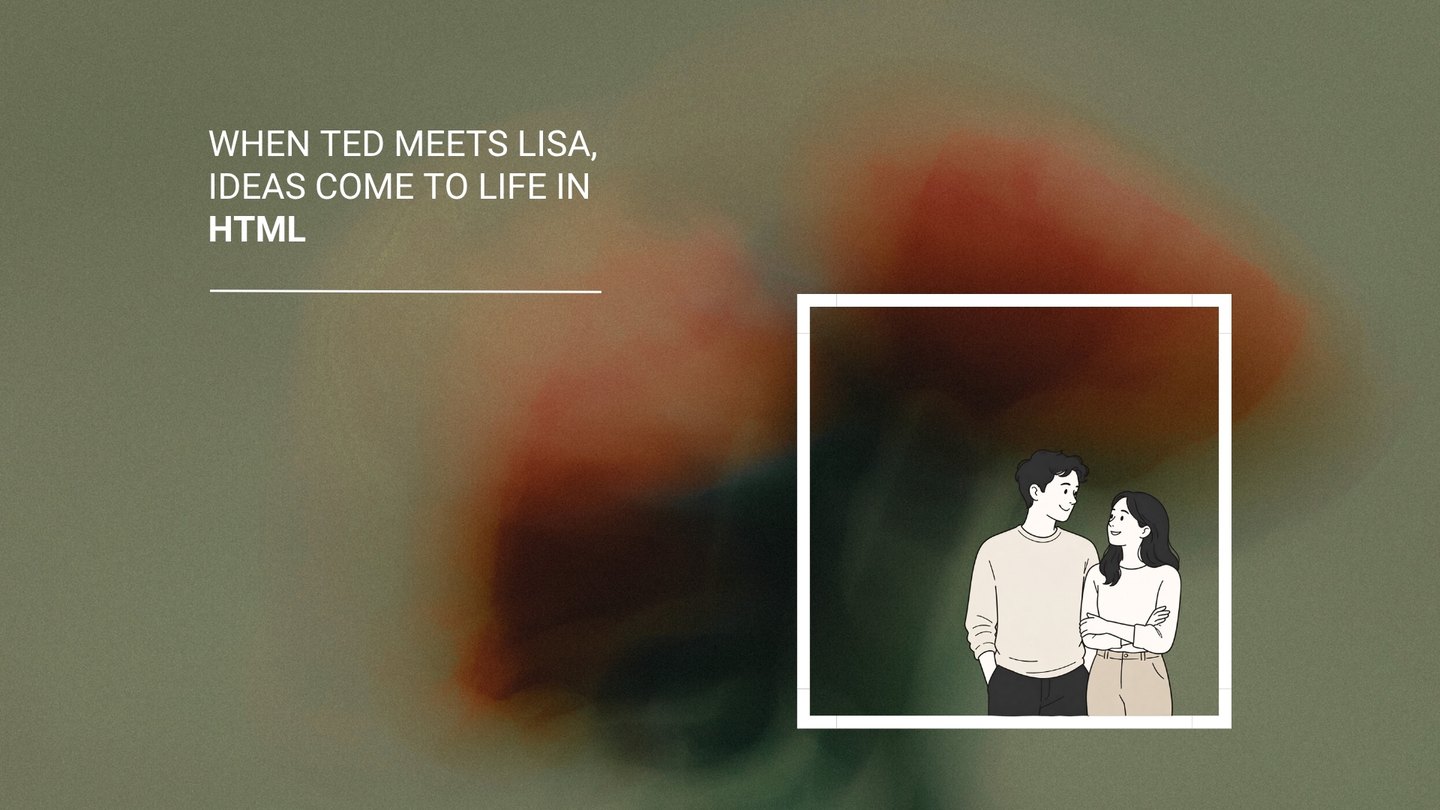
When Ted meets Lisa,
ideas come to life in HTML
Tell Lisa what you need — slides, a document, a diagram, a site. Answer a short visual intake, and your agent hands back one standalone HTML file: open it, present it, print it, email it. No build step, nothing to install.
@monomind ai lab
New here?
Three ways to your first file.
Pick what fits. Every path ends the same way: one finished HTML file, handed to you by your own agent.
Fill in the panel on this page — it asks what this is about, who it is for, and what shape it should take. The last step hands back one prompt with every answer baked in, so your agent asks nothing further and starts building immediately.
Copy the short prompt — nothing to fill in. Your agent fetches the skill and opens the same intake panel in your own browser, where you answer the questions. Short enough to send to anyone who wants a quick try.
Nothing to edit — share this prompt directly with anyone who wants to give it a quick try.
One install, both skills, available in every project. Other agents have their own plugin or skills directory — the layout is the same.
This is the part people miss: hand it any finished HTML file you like, and its visual system becomes a reusable template — extracted, stripped of its content, registered, thumbnailed. It's then one of your choices in the gallery, permanently.
What installing gets you
- The intake panel, served locally. Your agent opens it in your browser and picks the answers up itself — no copying.
- Your own templates. Hand
/lisa-new-templatea page you like and its look becomes a permanent choice in the gallery. - The design pipeline.
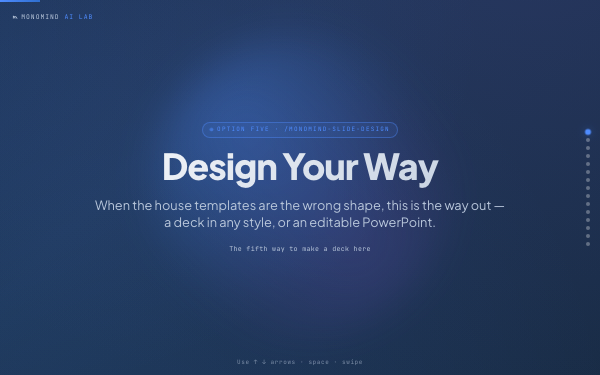
/lisa-designfor twelve style presets and animated slides — still one HTML file. - Every agent you use. The skill is plain Markdown and HTML — Claude Code, Codex, Pi, OpenCode, Hermes all read the same files.
The templates
Every shape, previewed for real.
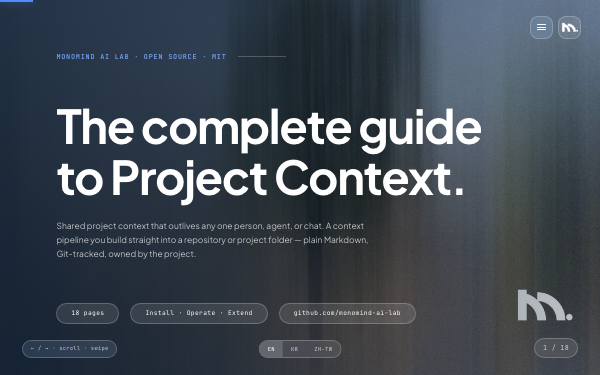
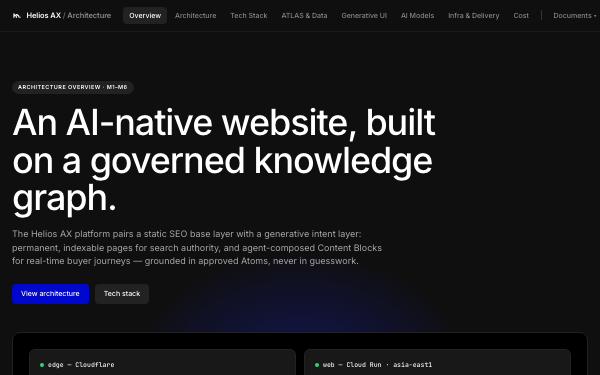
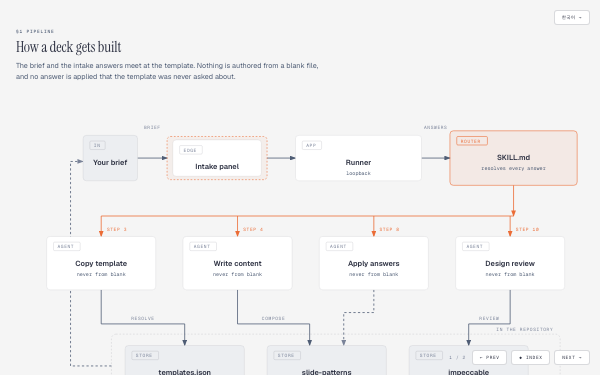
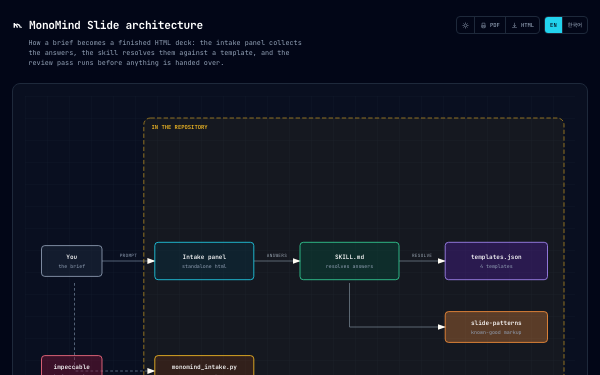
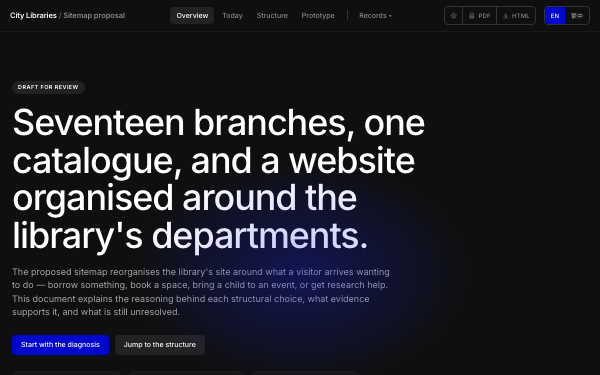
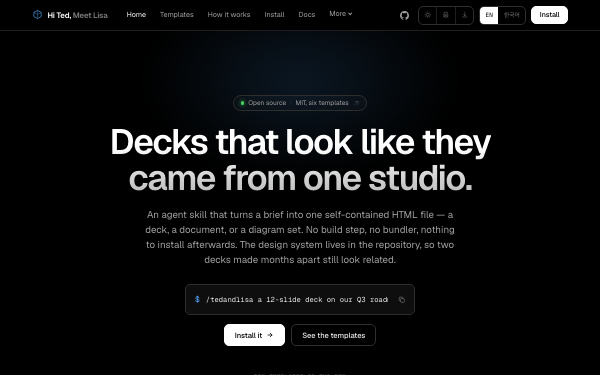
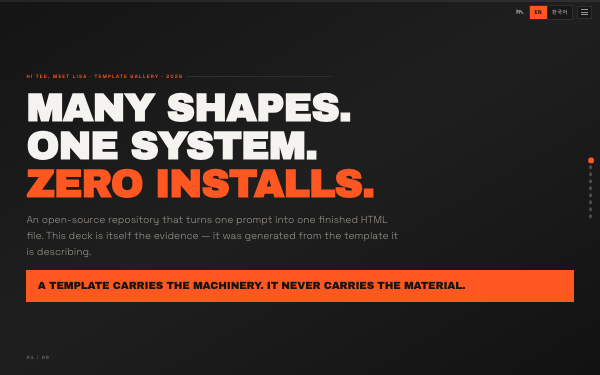
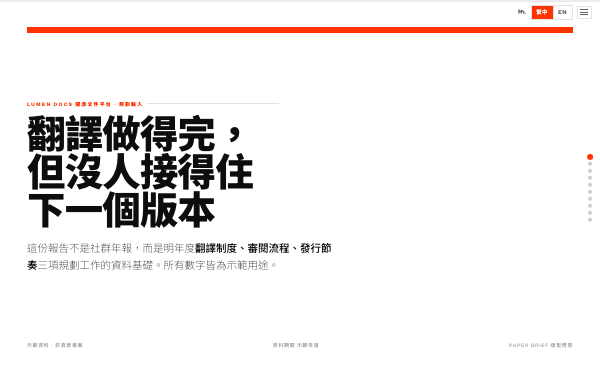
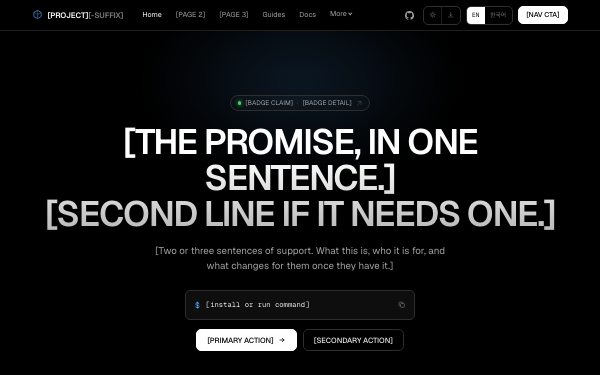
These are not mockups — every preview below is an actual generated file. Open one, present it, resize it. What you see is what the agent ships. More are on the way — and once installed, any page you like can join them.
Inside every file
Small file. Big machinery.
A file from Ted and Lisa is not a static export — it carries its own navigation, its own languages, and in some shapes, a working prototype.
Two languages, one file
English plus Korean or Traditional Chinese in the same file, switched in place. Filenames, commands, and product names are protected — they never get machine-translated into nonsense.
It presents itself
Scroll-snap slides, arrow keys, touch swipe, and a menu with contents — plus an optional HTML download entry and a Share menu that turns the file into a link on htmlbyme.com, right in the file's own chrome.
Light and dark, measured
Both themes ship in one file with a switch. A design review pass measures contrast in each — and behaviour at phone width — before the file is handed over.
Clickable website mockups
The Sitemap & IA shape doesn't just draw a site structure — it ends in a navigation prototype you can actually click through, at desktop and phone breakpoints.
Documents that argue
Some shapes are guided research, not slideware: information architecture proposals, system diagrams where colour means something, documents with decision records.
Diagrams that translate
Diagram-first shapes carry inline SVG — no CDN, works offline, and the labels inside the drawings switch language along with the rest of the file.
The medium
The beauty of one standalone HTML file.
Everything Ted and Lisa make ships the same way — a single
.html file. It sounds humble. It's the whole point.
- It opens anywhere. Double-click it, email it, drop it on any static host. Your audience installs nothing, signs into nothing.
- It's three deliverables at once. Present it as a talk, print it as a handout, read it as a document — the same file.
- Nothing in it can rot. No build step, no framework, no dependencies that expire. The file that works today opens the same way in ten years.
- It's yours to change. Plain, human-readable HTML and CSS — open it in any editor, or hand it back to any agent, and change what you like.
The whole idea
Ted has the idea.
Lisa gives it a frame.
You bring the brief; the agent does the building. What comes back is one file that opens anywhere and looks like it came from one studio.
For teams
Your brand, installed as a skill.
Everything on this page is the house style. The same machinery can carry yours: your design tokens, your components lifted verbatim from decks you already ship, your protected terms, your own intake — delivered as a private template pack your agent reads. You don't send us deck requests; we install the studio. Every file your team makes after that looks like it came from one studio — yours.
What you are looking at is one. The templates, their pattern references, the protected terms, the intake questions — that is our own pack, installed in our own agent, and every template preview in the gallery is its output. You don't have to take that on trust: the registry and the pattern references are public files in this repository.
A pack is your design tokens, one pattern reference per template, your protected terms, your own intake questions, and the install — in your agent, not ours.
Built by MonoMind, the studio behind this site.